The Mini Traveler
An Austin Mini, a rooftop tent, and thousands of kilometers of gravel roads: Andrés and Caro explain how their tiny car became their home, compass, and passport to adventure.
An Austin Mini with a rooftop tent has carried Andrés and Caro across South America, from Arica to Punta Arenas, Ushuaia, and Argentina’s Atlantic coast. In this conversation, Andrés describes the car’s mechanical challenges, the vulnerability of crossing the Atacama Desert, the kindness of strangers, and the couple’s next goals: Puerto Williams in the short term and Alaska someday. Their message is simple: adventure does not require the perfect vehicle.
““Those excuses—‘I don’t have the right car,’ ‘I don’t have a fully outfitted 4x4 camper truck,’ or whatever—are just details. What matters is wanting to do it, getting out there, and finding the courage. Go for it.””
An iconic Austin Mini, a rooftop tent, and a conviction forged on gravel roads: the size of your vehicle does not limit the scale of your adventure. Andrés and Caro have driven across South America, from Arica to Punta Arenas, reaching Ushuaia and exploring Argentina’s Atlantic coast.
Along the way, they have faced nighttime breakdowns, desert isolation, snow, mud, dunes, and the practical challenge of sharing a tiny cabin when Andrés is 1.93 meters tall. In this conversation, Andrés describes how the Mini stopped being a city car and became their home and compass.
From city car to travel companion
We all have that “crazy” moment when we decide to cast off. For you, what was it like when the Mini stopped being a city car and became your home and compass?
Andrés: “Honestly, it didn’t happen overnight. It was gradual. I’ve been a gearhead since I was a kid, and I’ve always liked Austin Minis. Growing up, I heard all these stories because it was such an iconic car in Chile—and really, all over the world. Stories about families traveling long distances.
“I’m from Puerto Varas, for example, and people would talk about a family of five piling into an Austin Mini to visit relatives in Santiago, driving all the way there and back. I grew up with those stories.
“So when I got one—I’ve had this one since the pandemic—I caught the bug. I started going to Mini events, and my first was in La Serena. I hadn’t owned the car long, but I said, ‘Right, I want to go to La Serena. It’s 1,500 kilometers.’ I went, and that was the first trip. It was August 2022, our first big outing. I actually went without my family, with just a friend. From there, everything gradually came together.”
The first long trips and the rooftop tent
How did you feel leaving home for the first time with the tent on the roof?
Andrés: “Our first big trip actually wasn’t with the tent. On my first trip with Caro, it was the two of us and our friend Adolfo in another Mini. We’d been invited to an Austin Mini gathering in Paraguay. We started organizing everything, then thought, ‘Hey, instead of going straight to Paraguay, why don’t we explore along the way?’ We ended up traveling through part of Argentina, all the way across Uruguay, southern Brazil, and Paraguay.
“That’s when we started thinking about a tent and figuring out how to make it work. At least here in Chile, nobody had done it. For the rest of the world, I could only find one photo online, and you couldn’t see much.
“On that trip, we looked for hostels and places to stay, but several times we couldn’t find anything. We’d reach a town or city late and have to sleep in the car. As you know, an Austin Mini is tiny—and I’m 1.93 m tall—so it wasn’t very comfortable. That got us thinking about the tent.
“Our first trip with it was aimed at reaching Ushuaia. We didn’t know how, but that was the goal. We were nervous because it was the first time we’d really headed out alone, without any other cars. We went south through Chile, drove the entire Carretera Austral, then headed back north a little and crossed into Argentina. We visited Torres del Paine and Punta Arenas, crossed to Tierra del Fuego, and made it to Ushuaia.
“On that first trip with the tent, my thought the whole way—because we drove a lot of gravel and rough stretches of Route 40—was: ‘Please hold up! Please don’t fall off or break the car’s roof!’ But we’ve now driven about 30,000 kilometers, maybe a little more, with the tent up there, and we haven’t had any of those problems.”
When strangers become part of the journey
What moment restored your faith in the kindness of strangers?
Andrés: “We have so many stories, almost enough for a book. A lot has happened to us, and some little ‘angel’ always turns up along the way to help.
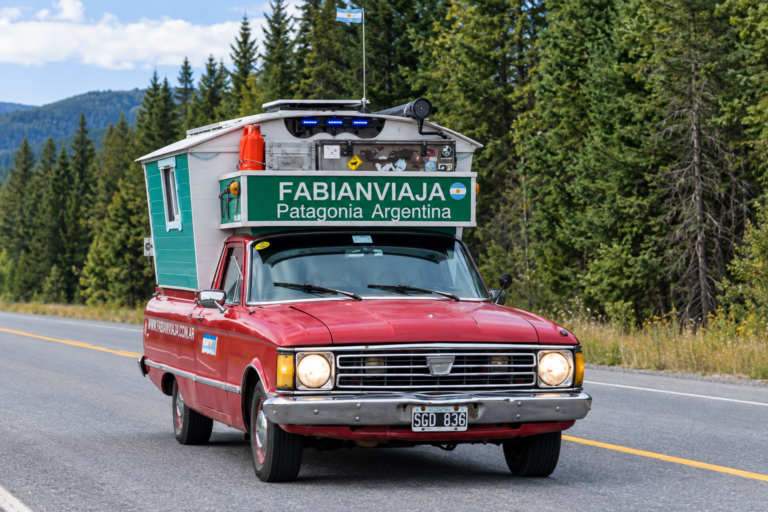
“For example, coming back from Ushuaia along the Atlantic coast on Route 3, we left Río Gallegos hoping to reach Rada Tilly. We were heading there because I’d written to Fabián, from Fabián Viaja—the Argentine traveler who drives a Ford Ranchero. I never thought he’d answer, but he did. We ended up running late on the road.
“Around 11 p.m., near Caleta Olivia, we lost drive to the wheels. We’d had a mechanical failure I couldn’t fix there. Caro usually reads a book to stay calm when we have a little problem, but this time she could see I was really struggling. She said, ‘If anyone stops, ask them for help right away.’
“We’d been driving for hours without seeing anyone because it was late and the weather wasn’t great. Just as she said that, a pickup appeared. They stopped and asked, ‘Do you need help?’ We said, ‘Yes, please.’ They towed us to Caleta Olivia and dropped us at a hotel, where we could ask about a repair shop. It was about 1 a.m. The guy at reception said, ‘I know someone,’ and called him right then. The mechanic answered and said, ‘Don’t worry. I’ll come rescue you tomorrow.’
“He picked us up early, we went to his shop, and we took things apart. One part needed repairing. He said, ‘I have a friend with a machine shop.’ We went there, and in three or four hours, the car was running again.
“We have lots of stories like that. So many good things have happened, always meeting people and making friends. The travel community is incredible—and so are people who aren’t travelers. In the end, you realize the world isn’t quite the terrible place the news makes it out to be.”
The Mini as a passport
Does traveling in such a beloved classic make it easier for people to stop, talk, and share their own stories?
Andrés: “Absolutely. It makes everything easier. Wherever we stop in the Mini, people come over to chat, help us, give us tips. It’s incredible. It opens so many doors—it’s our passport to all sorts of things.
“When we head out, we have a destination in mind, like Ushuaia. Last year, for example, we traveled the length of Chile, from Arica to Punta Arenas, without much of a plan. We go wherever the wind takes us, you could say! The car has helped a lot. People smile and come over out of curiosity to ask about it.
“And because it’s such an iconic car in Chile and around the world, most people have an Austin Mini story. They had one, or their dad or uncle did, or they learned to drive in one. We’ve even heard a lot of dating stories …
“Once we met an older couple, and the husband had asked his wife to be his girlfriend inside an Austin Mini. He used to rest his hand on her leg because the car was so small! There are endless stories.”
Fear, organization, and life in a tiny cabin
When has fear crept in on the road, and how did you help each other stay calm?
Andrés: “Being in such a small car really does make you see the world differently. You feel a little more vulnerable than in other vehicles, but you get used to it. What I don’t like is big cities with heavy traffic. Sometimes a truck goes past and all I can see is its wheel—that’s a little scary. But we’ve been lucky. Nothing has ever happened to us: no scares or near misses.
“We don’t spend much time in big cities, either. My favorite route is the Carretera Austral. Last year I drove the whole thing twice in the Mini, in summer and winter. The Mini really handles it well.
“We have our own way of organizing things. I make sure the car runs, and Caro handles ‘playing Tetris’ with everything inside. Besides the tent, we carry a table, chairs, a camp stove, and a cooler. The trunk is nothing but tools and spare parts. While I check the car, she organizes everything each day and makes sure it all fits.”
What have you learned about each other that you might never have discovered living in one place?
Andrés: “The car is really small, but Caro and I don’t have much trouble getting along. We each have our jobs. I keep it running and do the driving; she keeps everything organized inside. It’s funny—as I said, I’m 1.93 m tall, so if I roll down both windows and stretch my arms out, I can put one arm out each side. It really is tiny.
“But honestly, it’s never been an issue. It’s not as though we’ve been traveling for a year straight or anything. We go away for shorter stretches.
“We haven’t figured out how to fund ourselves indefinitely yet, so we go away in summer, for example. Caro is a teacher and has three months off in the summer, so that’s when we sneak away. I’m self-employed, so I can leave whenever I want, but when I’m away, I stop earning. That’s why we haven’t managed to go for longer.
“We’ve still covered a lot of ground. In 2025, for example, we drove 30,000 kilometers. We traveled the length of Chile, from Arica to Punta Arenas, went to Ushuaia, and explored Argentina’s Atlantic coast. We’re getting there. With all the excitement of the trip, we haven’t had any problems getting along, at least.”
Desert vulnerability and the road ahead
Where did you look in the rearview mirror and think, ‘I can’t believe the Mini brought us all this way’?
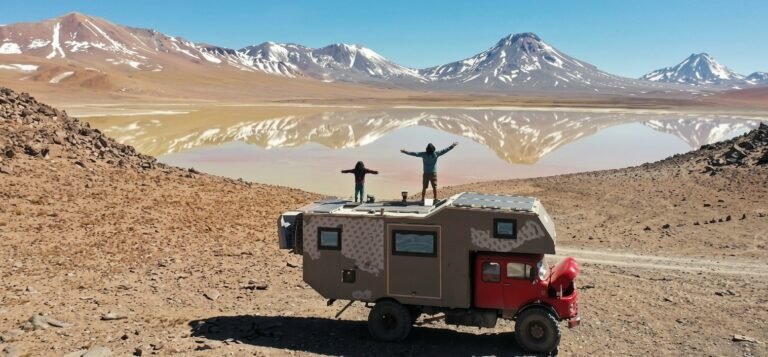
Andrés: “The place where I felt farthest from home was the Atacama Desert. We were alone, and the sheer size of it gave me a really strange feeling. I felt vulnerable and far away. We’d been to Ushuaia, Brazil, Paraguay, and Uruguay, but on those trips we had a friend along in another Austin Mini. It wasn’t the same—you feel you have more backup if something happens.
“But crossing the desert, I really felt far away and vulnerable. On top of that, we had mechanical problems and were alone fixing them three or four kilometers off the highway. It felt like something out of a movie.”
If the Mini could talk, what would it say about how you treat it and the adventures you take it on?
Andrés: “That’s a controversial question! People think the Mini is saying, ‘Come on, let me rest.’ But I think it’s sitting there itching for the next big adventure. It hasn’t been easy on the car, because honestly, whatever comes up, we do it.
“We’ve driven something like 500 kilometers of gravel, gone into the dunes in the Atacama Desert, gotten stuck in those dunes, driven on the beach, through mud, and through snow. The poor thing has had a hard time, but we’ve always made it there and back. I’ve never come home on the back of a truck or anything like that. We’ve had problems, but we’ve always managed to solve them. I’m sure the car has a soul and is looking forward to the next trip.”
What new goals have appeared on your dream map?
Andrés: “My dream—mine, Andrés’s; Caro’s not quite as keen because it scares her a little—is to reach the northern end of the Pan-American Highway, in Alaska. I’d love that. We have to figure out how to finance something like that, but I want to do it at some point in my life. I don’t know whether it’ll be now or when I’m old, but that’s the dream.
“In the short term, I really want to get to Puerto Williams. It was part of the plan when we went to Ushuaia, but we hit bad weather and the boats were canceled. Since I’m Chilean, I’d love to reach the southernmost city in Chile—and in the world. Last year, we traveled much of the country, from Arica to Punta Arenas. I want to finish that journey and be able to say, ‘From Arica to Puerto Williams.’ That’s the short-term goal. We’re hoping to do it this year.”
“It doesn’t matter what car you have”
What would you tell someone longing to go but thinking of a thousand reasons not to?
Andrés: “My message to people who are thinking about it is: do it. It doesn’t matter what car you have. Think about it—the Mini is just about the least suitable car for a long trip, and we’ve driven something like 60,000 kilometers around South America in the past three or four years.
“Yes, you’ll have bad days. You’ll struggle. But when you weigh the pros and cons, it’s absolutely worth it. You meet people and see places—it’s beautiful. The news paints the world one way, and when you get out there, you realize it isn’t like that. Of course there are bad people, but most people are good, friendly, and willing to help. It’s incredible.
“Those excuses—‘I don’t have the right car,’ ‘I don’t have a fully outfitted 4×4 camper truck,’ or whatever—are just details. What matters is wanting to do it, getting out there, and finding the courage. Go for it.”