The Dream in a Ranchero: From Ushuaia to Alaska
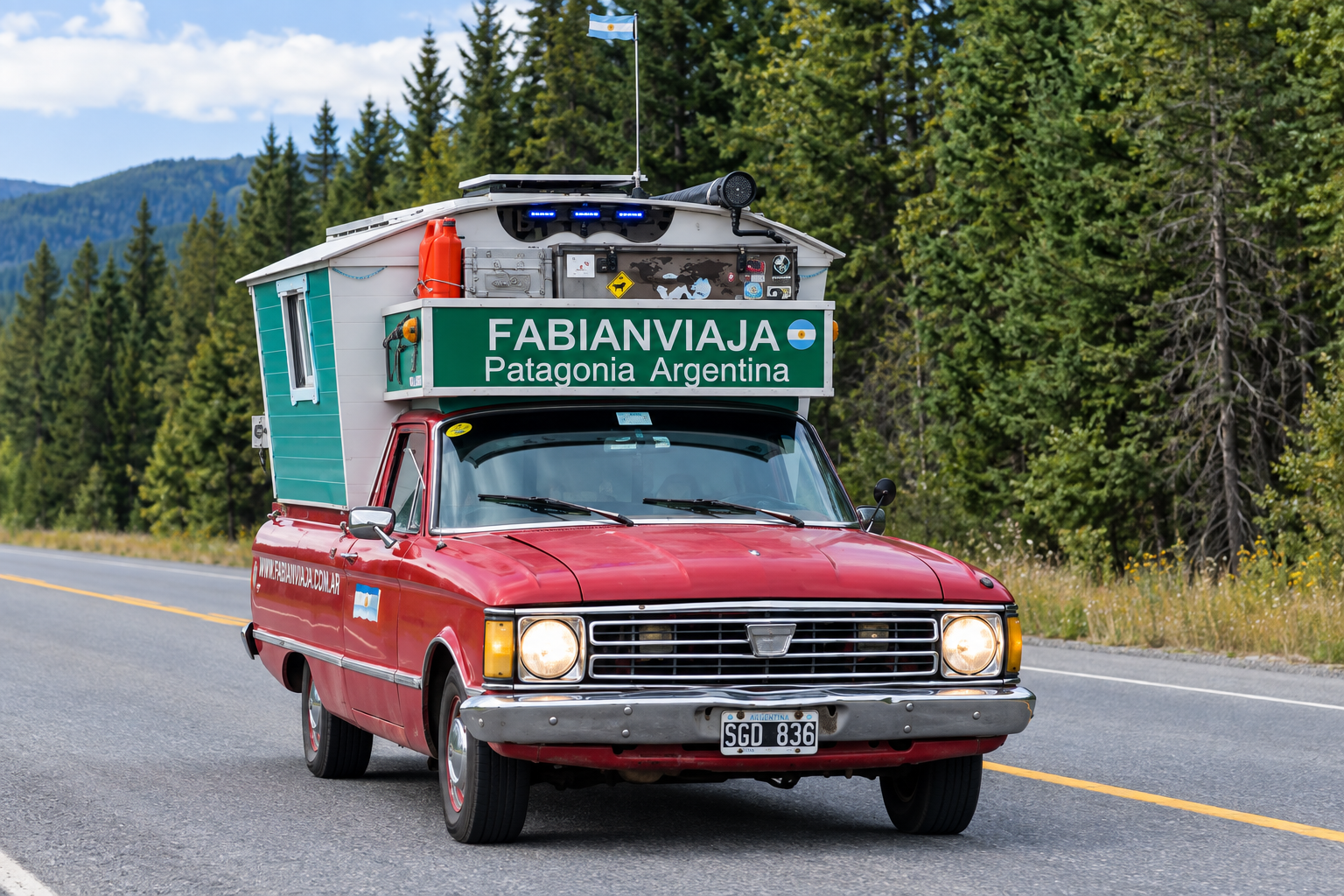
At more than 60, Fabián Figueroa connected Ushuaia with Alaska in a classic Ford Ranchero fitted with a handcrafted wooden camper. Along more than 30,000 kilometers, breakdowns, border crossings and changing plans became part of a journey that continues through Baja California.
At more than 60, Fabián Figueroa connected Ushuaia with Alaska in a classic Ford Ranchero fitted with a handcrafted wooden camper. His journey covered more than 30,000 kilometers, survived major mechanical failures—including a Ford Mustang cylinder head adaptation—and continued beyond Fairbanks. Now in Baja California, Fabián travels slowly, stays longer in each place and plans to eventually return the Ranchero to Argentina for one final tour.
“Reaching 60 years old does not mean not being able to travel; people see that there is still much to live for and do.”
By Macarena Orozco
Photography courtesy of Fabián Figueroa
Fabián Figueroa broke all the rules of overlanding by connecting Ushuaia with Alaska in a classic Ford Ranchero. More than 30,000 kilometers, mechanical failures in the middle of nowhere and a handcrafted wooden camper turned the journey into an experience that continued to transform him mile by mile.
Now touring Baja California at a slower pace, the Patagonian traveler looks back on the road, the machine and the dream that began long before he reached the far north.
A Ranchero with a personal history
What was the technical—or purely emotional—analysis behind specifically choosing the Ford Ranchero for a 30,000 km transcontinental expedition?
Fabián: All my life I’ve traveled by motorcycle through South America and the plan to travel to Alaska someday was always there. I planned it on different motorcycles, but over the years I began traveling more in a motorhome and left two wheels aside a bit.
I chose a four-wheeled vehicle for comfort, but I didn’t want to isolate myself in a large motorhome, which also comes at a huge cost. I bought the Ranchero in 2012, originally, ironically, to load and carry the motorcycles.
It also has a strong emotional meaning: it was the trendy brand-new car when I was 15 years old and I treated myself to buying it as a personal whim.
Why the journey resonated
You broke the algorithm barrier by starting a successful digital career. Does your audience watch you for the nostalgia of the car, or because you represent the courage to execute a dream that many do not dare to fulfill?
Fabián: I think I do well mainly because I am over 60 years old and there aren’t many YouTubers of that age who are successful on the platform. It catches people’s attention to see someone my age traveling in these conditions. Logically, the nostalgia generated by an old classic car adds a lot.
Many of those who are 30 today realize, when watching the videos, that reaching 50 or 60 doesn’t mean being a useless old man who can’t travel; they see that there is still much to live for and do.
Learning to travel through Patagonia
How has your preventive maintenance protocol changed? Do you travel with a stock of critical spare parts or rely on mechanical adaptation on the road?
Fabián: I grew up and lived almost all my life in Patagonia, where distances are extremely long and in another era there were almost no paved roads. You grow up anticipating what can happen on the road.
That is why I always carry basic spare parts to help myself or someone else in the middle of nowhere: a fan belt, points and condenser, a set of spark plugs, tools, wire, and electrical tape. It is the school that comes from having driven all your life in Patagonia.
Breakdowns, adaptation and the “Mustang-ization”
What was the most serious mechanical failure or logistical error that made you think the expedition was over?
Fabián: The most typical failure was that the thermostat got stuck, the temperature rose, and the cylinder head gasket blew; water was getting into the cylinder, so I had to take off the head and change the gasket. Despite that, it never crossed my mind to end the trip.
In life, everything can be fixed except death; ultimately, if the engine was completely done, I’d buy another one and keep going.
Curiously, the mechanical story had its climax entering the United States. There, the original cylinder head completely cracked and started spitting steam out of the exhaust. Luckily, I managed to reach Roseville, near Sacramento, where an Argentine friend has a shop. We took everything apart and put on a cylinder head from a Ford Mustang; so now the Ranchero has officially been “Mustang-ized”!
A wooden camper built for the long road
How do you manage material fatigue, chassis flex and the weight distribution of your handcrafted wooden structure against vibrations from gravel roads and high-speed highways?
Fabián: High speeds don’t affect me because I travel very calmly, keeping a steady 80 km/h. As for the camper’s structure, it has performed wonderfully. I haven’t had any issues with breakages, nor has the wood rotted anywhere.
The only thing I did as preventive maintenance was repaint the roof to ensure no moisture leaked in. It was built with great care to last, and luckily it is holding up intact.
Fairbanks, not the sign, was the true goal
What did you really feel when you turned off the engine upon reaching Alaska?
Fabián: Reaching the famous “Welcome to Alaska” sign was like arriving at the next town; honestly, it wasn’t that exciting. The true emotional peak for me was reaching the city of Fairbanks.
In my youth, we would look at paper maps and Fairbanks was there, right in the middle of the Alaskan territory. That was my true goal since I was a kid. Curiously, I happened to arrive on a rather ugly and rainy day.
Did I feel that explorer’s void? Not at all, because I’m not one to load the car onto a ship in Alaska and consider the trip finished. In fact, since I arrived in Fairbanks, about six months have passed where I kept driving, and I’ve done over 10,000 extra kilometers.
The road continues through Baja California
On December 5th, my six-month visa in the United States expired, so I crossed the border into Mexico. Now I am traveling through Baja California at a much slower and more relaxed pace. I spend time with more people and stay several days in the same place; in fact, in two and a half months here I have barely covered about 2,000 kilometers.
What is the plan now in Mexico? Will the Ranchero be repatriated as a museum piece, or will it continue indefinitely on the road?
Fabián: Regarding the Ranchero, my definitive idea is to repatriate it at some point; I would never leave it abandoned anywhere in the world. I want to return to Argentina with it and take it on one final tour around the country so that the community that followed us can see it in person. But for now, we continue on the road.